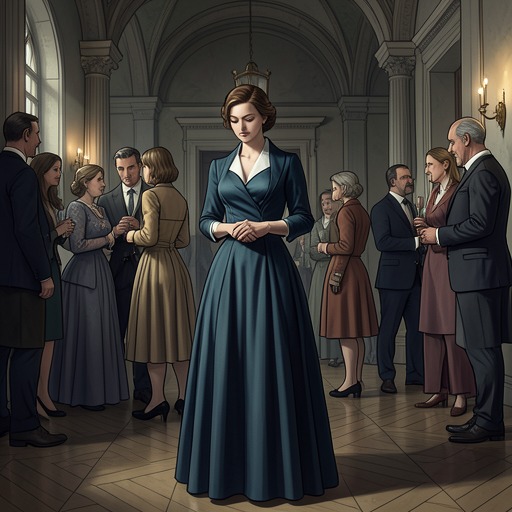
Katharine Hilbery accepts William Rodney's proposal
Night and DayKatharine Hilbery’s acceptance of William Rodney’s proposal is a consequential turn in their relationship, but not a simple triumph of romance. She has already told William that she is not in love with him and cannot marry him; later, she reverses that answer in a voice notably without joy, after imagining a more emotionally liberated life. Her engagement makes a private decision public, while leaving intact the novel’s tension between affection, obligation, and the inward life that marriage cannot readily contain.
Background: a refusal and a continuing friendship
Katharine and William meet again after exchanging letters about their relationship. Her reply to his protestation had been brief and practical: she said that she was not in love with him and therefore could not marry him, while hoping their friendship would continue unchanged. She added a postscript praising his sonnet. The distinction matters: she refuses marriage without ending their connection, and William takes the literary compliment as evidence that she admires the poet in him.
William prepares for their meeting with visible uncertainty, changing three times between a tail-coat and his old dressing-gown and repeatedly putting on and removing a pearl tie-pin. He settles on the dressing-gown after rereading Katharine’s postscript, reasoning that she prefers the poet and that a slightly shabby appearance suits him. He also speaks little and keeps to impersonal subjects, hoping to make her visit alone seem unremarkable, though he is not sure it is. The careful performance of ease contrasts with the fact that the meeting follows a refusal and carries personal stakes for them both.
Katharine’s decision
At the meeting, Katharine turns away from the prospect of marriage and falls into a dreamlike state. In this imagined world, feelings are free of the constraints imposed by ordinary life; its emotional realities seem more direct and powerful than those available in waking experience. She pictures herself loving a magnanimous hero and moving with him through an unknown landscape. The episode gives form to a capacity for inward experience that her outward decision-making does not express.
The dream ends as she hears signs of William moving things in his dressing-room. Katharine wakes, closes the book she has been holding, and puts it back on the shelf. She then addresses William, initially faintly, as though sending her voice from sleep into the living world, before repeating her offer firmly: if he still wants to marry her, she will. The movement from imagined freedom to a practical answer is abrupt, and the narration emphasizes the manner of the offer as much as its content.
William does not answer at once. Katharine waits with stoic patience; he then comes briskly out of the dressing-room and turns to the practical question of where they might buy more oysters. His shift to an everyday errand leaves the emotional meaning of the exchange understated. Katharine, in turn, breathes a deep sigh of relief. Her acceptance is decisive, but its subdued delivery and her relief complicate any reading of it as uncomplicated romantic fulfillment.
Announcement and family response
A letter from Mrs. Hilbery, sent a few days later to her sister-in-law, recounts how Katharine told her she had made up her mind and had written to William, whom she expected the next day. Mrs. Hilbery remembers sitting alone and feeling that nothing pleasant would happen again, then feeling unexpectedly happy when Katharine came and sat on the rug beside her. The account locates the engagement within the mother and daughter’s close emotional bond, not solely within the couple’s courtship.
Mrs. Hilbery initially resists the prospect of her daughter marrying anyone. She changes her position when Katharine assures her that marriage will make no difference to her enduring care for her parents. Mrs. Hilbery then tells her to give William everything, while confessing that she herself is willing to come second. Her response moves between tears, anxiety about age and loss, and hope: she imagines the young couple living nearby, visiting every day, and continuing the work on the biography together. The hoped-for marriage is thus imagined as a change in family arrangements that will not sever the mother-daughter connection.
Mrs. Hilbery’s letter also describes William as kind and true, though nervous and not commanding, and credits Katharine with the steadiness and capacity to rule that he lacks. Her approving account does not erase the unease surrounding the match: she admits that she had not wanted Katharine to marry anyone, then finds reasons to welcome this particular future. The engagement is received through the family’s expectations and affections as well as through the couple’s own decision.
Public confirmation and significance
The engagement later becomes explicit in a visit to Mary Datchet. When Mary returns with tea, Katharine tells her that William thinks she may not know and that they are going to be married. Mary shakes William’s hand and offers him congratulations, while addressing him as if Katharine were inaccessible; she has taken hold of the kettle. Katharine immediately turns to the practical business of tea-making, asking whether hot water goes into the cups first and whether William has a method of his own. The scene sets the formal announcement beside small domestic gestures, and Mary’s physical response registers the news without a direct explanation of her feelings.
Across these moments, the proposal’s acceptance is not presented as the culmination of a straightforward courtship. It follows an explicit refusal, a continuing friendship, and an inward dream whose emotional freedom contrasts with the ordinary obligations of marriage. Katharine’s answer changes their relationship and gives the family a future to anticipate, yet her level voice, her sigh of relief, and the family’s anxious hopes preserve the uncertainty beneath the announcement. The episode makes engagement both a social fact and a difficult personal accommodation.